
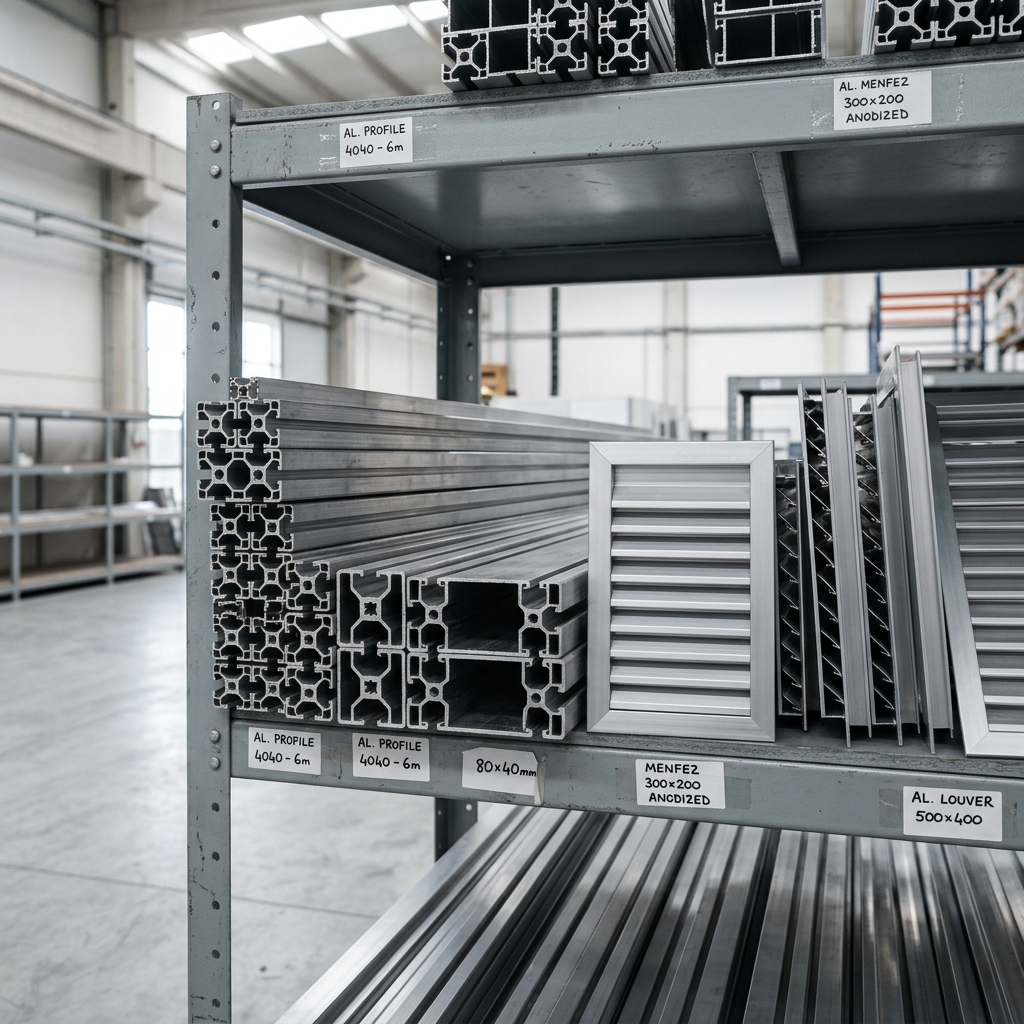
If the standard sections in the catalogue do not meet your needs, the solution is a custom aluminium extrusion: a special profile pressed to your drawing. This guide shows how a profile goes from drawing to series production, what information is needed for a quote, where the technical limits lie and which design rules make extrusion easier.
When do you need a custom profile?
A custom die makes sense when a standard profile is not enough, for example when:
- The section you need is not in the catalogue.
- You want to combine functions such as a nut slot, cable channel or gasket seat in one profile and save parts.
- You need tighter tolerances than EN 755 or a special surface finish.
- You want to reduce secondary operations (sawing, milling) in series production.
From drawing to profile: the process
The process typically follows these steps:
- 1. Enquiry and drawing: you send your 2D/3D CAD drawing, the application, preferred alloy and quantity.
- 2. Feasibility and die design: our engineers check that the section can be extruded (wall thicknesses, hollow chambers); the die is designed in-house with CAD/CAM.
- 3. Die manufacturing: the die is made in our own tool shop.
- 4. Trial extrusion and sample: a prototype is extruded, dimensions are compared with the drawing and the sample is approved.
- 5. Series production and processing: the series runs on our presses; anodizing or powder coating, cutting, drilling and CNC machining follow as required.
What information do we need for your quote?
For a fast and accurate quote, the following is enough:
- 2D/3D CAD drawing
- Application and load conditions
- Alloy and temper (if specified)
- Length and approximate annual quantity
- Surface finish (mill finish, anodized, powder coated)
- Tolerance and standard requirements
Technical possibilities and limits
The values below show the usual ranges for custom profiles; they are confirmed for each section in the feasibility study.
| Feature | Value |
|---|---|
| Weight | 0.080 – 18.0 kg/m |
| Circumscribing circle | up to Ø220 mm |
| Alloys | EN AW-6060, 6063, 6082, 6005A, 1050 |
| Temper | T4, T5, T6 |
| Geometry | solid, hollow and multi-chamber sections |
| Tolerances | EN 755 / EN 12020 or tighter per customer specification |
| Surface | as required, including hard anodizing |
| Processing | cutting, drilling, precision CNC machining |
Design tips for extrudable profiles
These general rules improve manufacturability and cost:
- Keep wall thicknesses as uniform as possible and avoid abrupt changes.
- Use radii instead of sharp inside corners.
- Avoid very narrow, deep slots and choose adequate wall thickness for hollow sections.
- Combine nut slot, cable channel and gasket seat in one profile.
- Specify tight tolerances only where they are functionally necessary; this reduces cost.
Frequently asked questions
When should I choose a custom profile instead of a standard one?
When the section you need is not in the catalogue or you want to combine several functions in one profile.
What do I need for a quote?
Your 2D/3D CAD drawing plus application, alloy, length, quantity and surface finish are enough; you can upload the drawing via the contact page.
Do you deliver abroad?
Yes, we export directly from Turkey to more than 50 countries.
Have a drawing ready? Upload it via the contact page, see examples on our custom aluminium profiles page or choose standard sections under standard extrusion profiles.