
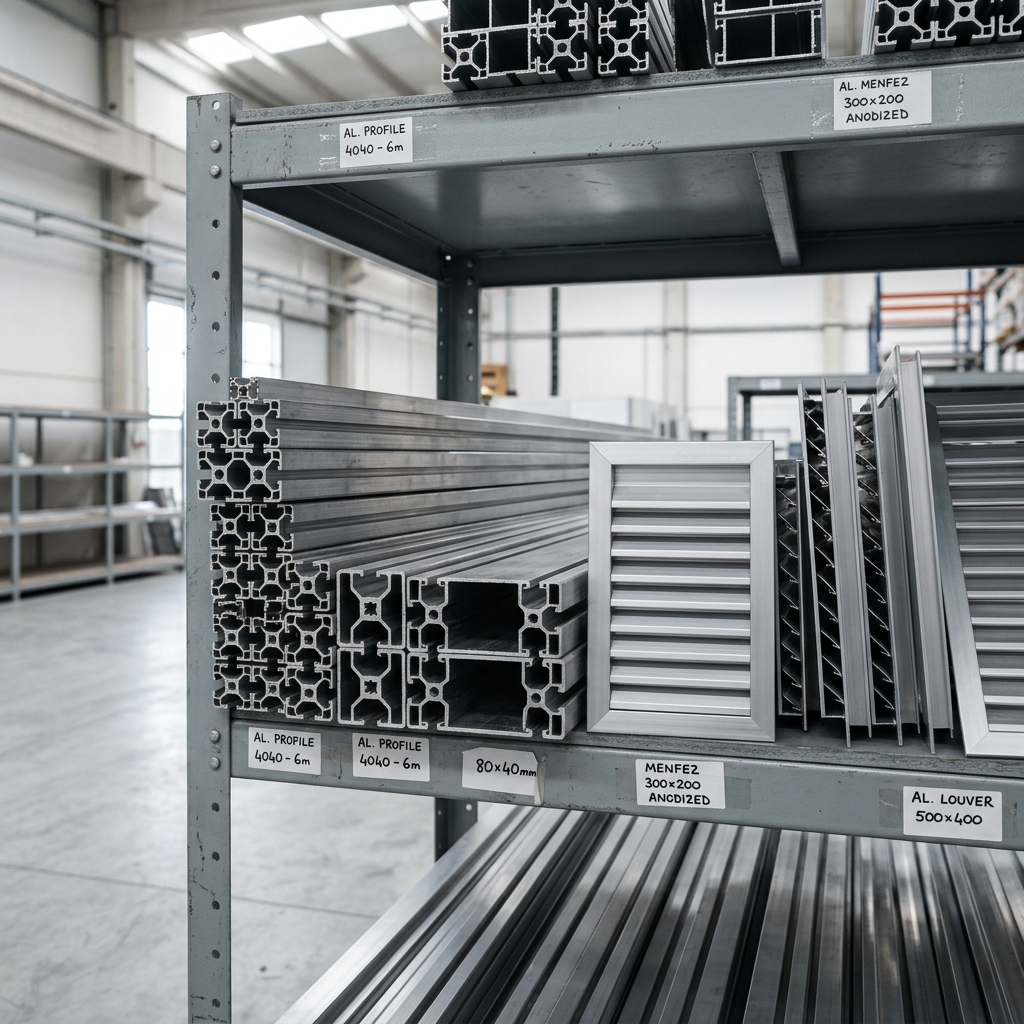
Production lines are rearranged as product variety grows and extended with sensors and robots. Flexibility, one of the core requirements of Industry 4.0, starts with the machine frame. A welded steel frame is heavy, needs painting, and has to be cut and re-welded whenever something changes. Modular sigma (T-slot) aluminium profiles offer an alternative that is bolted together and can be dismantled and rebuilt.
What is a sigma (T-slot) profile?
A sigma profile is an extruded aluminium profile with T-slots running along its faces. T-nuts or drop-in nuts placed in the slot fix corner brackets, panels, linear guides, sensor brackets and feet at any point on the profile. Common sections range from 20×20 mm to 90×90 mm and above, and slot classes of 6, 8 and 10 mm are in general use. The slot width determines which fasteners can be used and how much load can be carried.
What does modular aluminium give you over a welded steel frame?
- Low weight: At about one third the weight of steel, transport, installation and floor loading are reduced.
- No welding or painting: Thermal distortion, post-weld finishing and a paint line are no longer needed, and corrosion resistance is high.
- Reconfigurability: When the line changes, the frame can be dismantled and rebuilt, so the investment is preserved.
- Tidy appearance: Cables and pneumatic lines are hidden in the slots.
- Fast prototyping: A working prototype can be ready within days through cutting and joining.
For an honest assessment, the limits should also be stated: steel can still be the better choice for very heavy static loads, for long spans that need high stiffness at low cost, and for high-temperature environments. The elastic modulus of aluminium (about 70 GPa) is one third that of steel (about 210 GPa), so a larger moment of inertia is needed for the same deflection. This difference is compensated through section selection and profile geometry.
Basic calculations in frame design
The first step is to define the load and the permissible deflection. For a simply supported beam under a uniformly distributed load, the maximum deflection is approximately δ = 5·q·L⁴ / (384·E·I), where L is the span, E the elastic modulus and I the moment of inertia of the profile. When the span doubles, deflection increases about 16 times, so adding an intermediate support on long spans is often more efficient than enlarging the profile. In precision measurement or assembly stations, the permissible deflection is usually tightened to values such as L/1000.
The type of joint also determines stiffness. Corner brackets are quick; end-face and hidden joints give a stiffer structure; diagonal bracing reduces lateral sway. Bolt torques should follow the manufacturer's values, and in applications with vibration, locking elements or periodic tightness checks should be defined. Thermal expansion (about 23 µm/m·K) requires an allowance on long lines with changing temperatures.
| Application | Design priority | Recommendation |
|---|---|---|
| Machine guarding enclosure | Low weight, panel mounting | Small section (e.g. 30×30), polycarbonate or sheet panels; compliance with EN ISO 14120 |
| Conveyor and handling line | Dimensional stability, modularity | Medium section, intermediate supports, adjustable feet |
| Assembly station / workbench | Ergonomics, load capacity | Medium-large section, diagonal bracing, height adjustment |
| Measurement and test rig | Low deflection, vibration | Large section, rigid joints, short span |
| Robot cell base | Stiffness, high load | Large section, heavy-duty connectors, floor anchoring |
Integration with Industry 4.0
The profile slots allow sensors, cameras, light curtains, RFID readers and lighting modules to be positioned without drilling holes. When the line changes, these elements are simply slid along the slot. Cable channels keep data and power routed in an orderly way. If profile libraries (STEP/CAD) and bills of materials (BOM) are used at the design stage, the digital model stays consistent with the real line and change management becomes traceable.
Safety and standards
Machine guards should be handled under EN ISO 14120, and risk assessment under ISO 12100. In the design, the guard's resistance to impact and push loads, the mounting points for safety switches and emergency stops, and the covering of sharp edges and trapping points should be planned from the start.
Alloy, tolerance and surface
Sigma profiles generally use 6060 or 6063 alloy in the T5/T6 temper. Section tolerance is critical so that the T-nut works smoothly in the slot and parts join without error, which is why the EN 755 and EN 12020 tolerances matter. A natural anodized surface protects against wear and is easy to clean.
A quick start with Reel Aluminium
Alongside standard sigma profile families, we make the dies for special section needs in our own tool shop and can move from design to first sample within 2 weeks. We deliver profiles ready to assemble, with precision cutting, drilling and CNC machining. Under our ISO 9001 quality system, we keep the same standard from sample to series production.
Checklist for frame design
- Have static and dynamic loads and the permissible deflection been defined?
- Are the section and slot width compatible with the fasteners?
- Have intermediate supports or diagonal bracing been added on long spans?
- Have the guards been assessed according to EN ISO 14120?
- Has a slot plan been prepared for sensor and cable routes?
For section selection, custom profile development or cut-and-machined delivery for your machine frame, you can contact our engineers.