
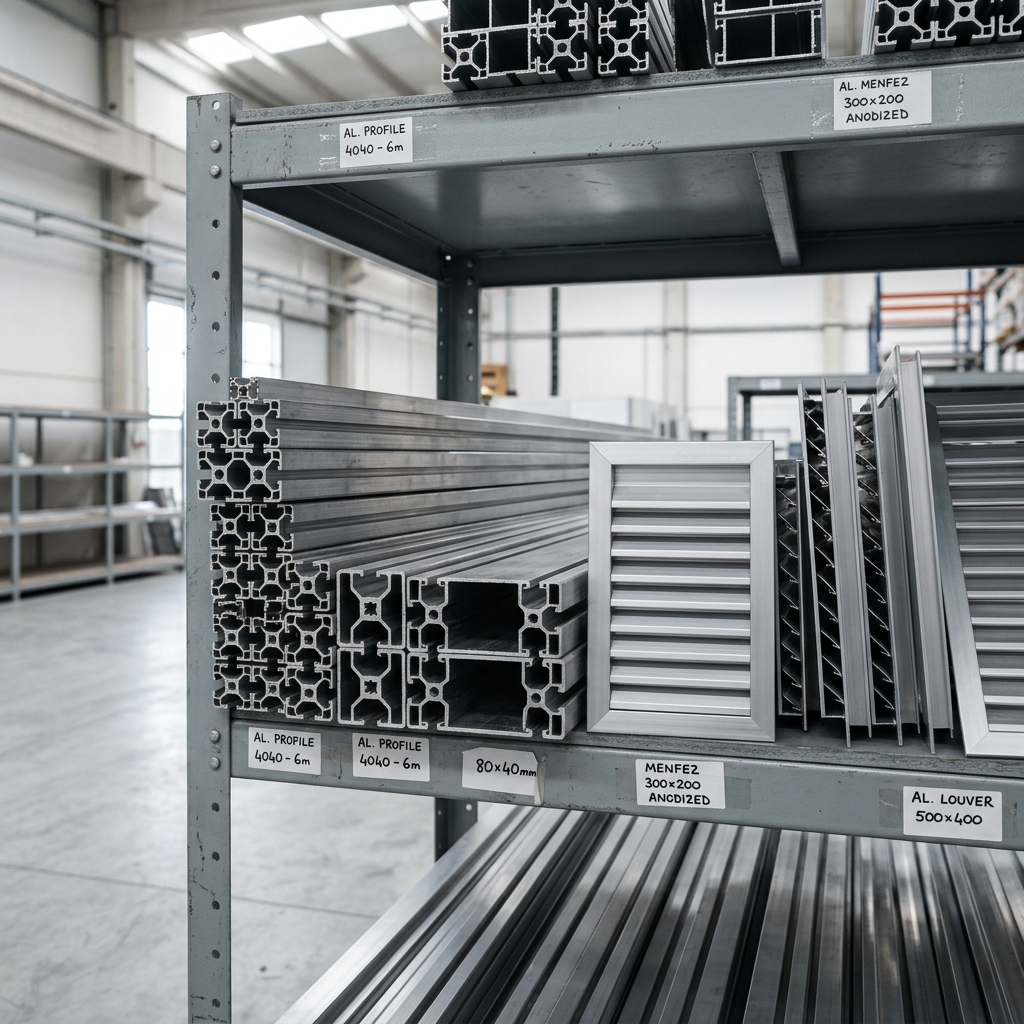
When choosing an aluminium profile, the first questions are usually "which section, which size, and what does it weigh per metre?" This guide brings together the standard aluminium profile types, example sizes from our catalogue and the weight-per-metre (kg/m) calculation, so you can narrow down the right section and alloy before requesting a quote.
Standard aluminium profile types
Standard profiles are universal geometric sections that can be used directly, without opening a new die. Our catalogue includes these groups:
- Angles (L profiles): Equal or unequal legs, used for frame corners, edge protection and connections.
- U-channels: Used for channels, guides and frames, and to wrap the edges of glass, panels or sheets.
- T-bars: T-shaped sections used for support, partitions and joints.
- Box sections: Square and rectangular hollow sections for light structural frames and constructions.
- Round tubes: Defined by outside diameter and wall thickness; common in furniture, railings, signage and industrial frames.
- Round and square bars: Solid sections used for machining and part manufacturing.
- Flat bars: Flat strips defined by thickness and width, used as connection plates, reinforcement and edge bands.
Example sizes and weights from our catalogue
The tables below are example rows taken from our catalogue; see the catalogue link at the bottom of the page for the full size list. Dimensions are in mm and weight in kg/m.
Angles (L profiles)
| a × b × wall thickness (mm) | kg/m |
|---|---|
| 10 × 10 × 1 | 0.052 |
| 20 × 20 × 1.5 | 0.157 |
| 30 × 30 × 3 | 0.463 |
| 40 × 40 × 4 | 0.823 |
Box sections
| a × b × wall thickness (mm) | kg/m |
|---|---|
| 15 × 15 × 1.5 | 0.211 |
| 20 × 20 × 1.5 | 0.302 |
| 40 × 40 × 2 | 0.824 |
| 40 × 80 × 1.3 | 0.826 |
Round tubes
| Outside Ø D / inside Ø d × wall thickness (mm) | kg/m |
|---|---|
| 20 / 17 × 1.5 | 0.236 |
| 40 / 36 × 2 | 0.648 |
| 50 / 40 × 5 | 1.915 |
| 100 / 96.7 × 1.65 | 1.381 |
Flat bars
| Thickness × width (mm) | kg/m |
|---|---|
| 2 × 20 | 0.108 |
| 5 × 20 | 0.271 |
| 10 × 20 | 0.542 |
| 15 × 120 | 4.878 |
Similar size tables for U-channels, T-bars, round bars (e.g. Ø8 mm: 0.136 kg/m; Ø12 mm: 0.306 kg/m) and square bars (e.g. 7 mm: 0.133 kg/m) are included in the catalogue.
How to calculate the weight per metre of an aluminium profile
Because the density of aluminium is about 2.7 g/cm³, the weight per metre of a profile follows directly from its cross-sectional area:
Weight (kg/m) ≈ cross-sectional area (mm²) × 0.0027
Example: a Ø8 mm round bar has a cross-sectional area of about 50.3 mm², so 50.3 × 0.0027 ≈ 0.136 kg/m. For a 3 × 25 mm flat bar, 75 mm² × 0.0027 ≈ 0.203 kg/m. Corner radii can make the real value differ slightly from the calculation; use the catalogue value for exact weights.
Choosing the alloy and surface finish
The most common alloys for standard profiles are EN AW-6060 and 6063, chosen for their good machinability, weldability, formability and suitability for anodizing. Where higher strength is needed, 6082 and 6005A alloys are also available. Profiles can be supplied mill finish, anodized or powder coated. Anodizing or coating is common for outdoor and visible applications, while mill finish is usual for internal structures and machined parts.
Standard profile or custom die?
If standard sections meet your needs, you can select from the sizes in the catalogue. If you need a section that is not in the catalogue, a special channel or a joint detail, we can develop a custom die to your drawing in our own tool shop. See our custom aluminium profiles page for example applications.
What determines the price of an aluminium profile?
Aluminium profile pricing is shaped project by project rather than by a fixed list price, mainly by:
- Weight: The kg/m of the profile and the total length; raw material cost is proportional to weight.
- Alloy and temper: Differences can arise between 6060/6063 and higher-strength alloys.
- Surface finish: Mill finish, anodizing or powder coating.
- Cutting, drilling and CNC machining: Additional processing for site-ready parts.
- Quantity and delivery: Order quantity and shipment method.
For an accurate quote, send the dimensions (or profile number), alloy, surface finish, length and approximate quantity.
Frequently asked questions
What are the standard aluminium profile sizes?
The catalogue includes angles, U-channels, T-bars, box sections, round tubes, round and square bars and flat bars; sizes vary by profile type. On our product page the size range is from 10 mm up to 300 mm with wall thicknesses from 1.0 mm to 15.0 mm.
Can I order by profile number?
Yes. Every section in the catalogue has a number; simply quote it when requesting a quote.
Can I receive profiles cut or machined?
Precision cutting and CNC machining are available; please state your requirement in your quote request.
To find the size or section you need and to see all the tables, you can download our standard profiles catalogue, browse our product group on the Standard Aluminium Extrusion Profiles page and request a quote.