Solar power plants (PV) are infrastructure investments built for an operating life of at least 25–30 years. Although panels and inverters take the spotlight in investment appraisals, it is the mounting system carrying them that determines the safety and yield of the whole plant. Rails, clamps and structural elements must hold the tilt and alignment of the panels for decades under wind, snow, temperature swings and corrosion. The rail is a small item in the total investment, and the cheapest solution can come back in later years as high maintenance and failure costs.
Components of the mounting system
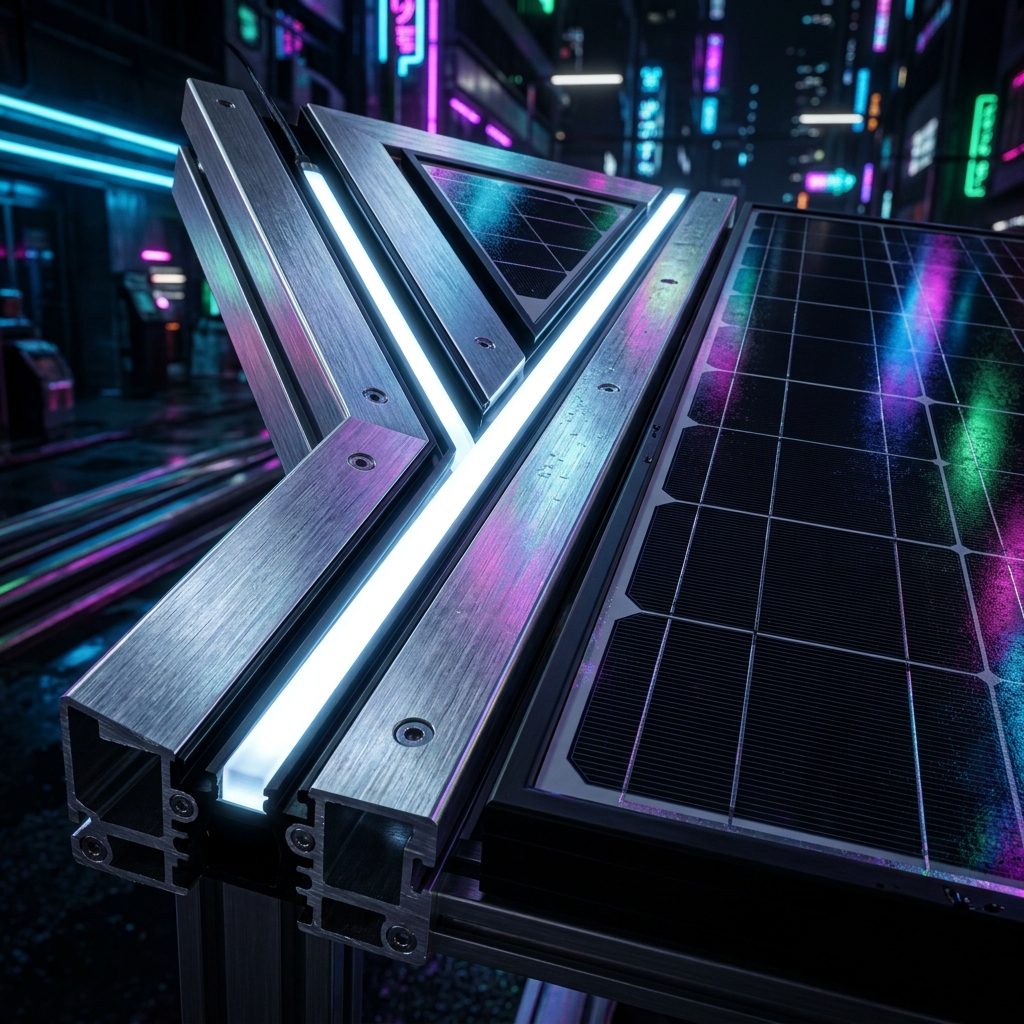
In rooftop installations, aluminium rails are fixed to roof hooks or to fasteners on trapezoidal sheet; the panels are secured with the T-slot on the rail or with mid and end clamps. In ground-mounted plants, the supporting posts and trusses are mostly made of galvanized steel, while the rails in direct contact with the panels are aluminium. In most projects, hybrid solutions strike the balance between cost and durability.
Why aluminium rails?
- Corrosion resistance: A long life in humidity, rain and salty atmospheres, thanks to the natural oxide layer and anodizing.
- Low weight: At about one third the weight of steel, the additional load on the roof is reduced and transport and installation are easier.
- Design freedom: Extrusion integrates the clamp slot, cable channel and drainage geometry in a single part.
- Fast installation: Pre-cut and pre-drilled rails shorten on-site time.
- Recyclability: At the end of its life, the material is recycled without loss of value.
Choosing the alloy and temper
Solar rails commonly use the T5 or T6 tempers of the 6063, 6005A and 6082 alloys. The values below are approximate minimum mechanical properties under EN 755-2; they vary with section thickness, and project calculations should be based on the relevant standard and the manufacturer's certificate.
| Alloy / Temper | Rp0.2 (MPa), approx. min. | Rm (MPa), approx. min. | Typical use |
|---|---|---|---|
| 6063-T5 | 110 – 130 | 160 – 175 | Light load, short span |
| 6063-T6 | 170 | 205 – 215 | Medium load, standard roof rails |
| 6005A-T6 | 200 – 225 | 250 – 270 | High load, long span |
| 6082-T6 | 250 | 290 | Heavy load, ground-mount structures |
Load calculations and thermal expansion
Wind and snow loads are determined under EN 1991-1-4 and EN 1991-1-3, and aluminium structural members are sized under Eurocode 9 (EN 1999-1-1); local snow and wind maps and national standards must also be taken into account. Wind suction (uplift) is often the governing load, and the weakest link in the chain of clamp, rail and roof connection should be identified by calculation.
Thermal expansion must not be ignored either. With an expansion coefficient of about 23 µm/m·K, a 6 m rail lengthens by about 7 mm over a 50 K temperature change. On long rail runs, expansion allowance, slotted holes and sliding connections must accommodate this movement.
Surface treatment and galvanic corrosion
Anodizing is a common choice for solar rails for both corrosion and wear resistance. In outdoor applications a coating thickness of 15–20 µm (Qualanod class 15–20) is typically chosen, and higher classes in marine environments. When aluminium meets other metals, there is a risk of galvanic corrosion. If stainless steel (A2/A4) fasteners are used, direct metal contact should be prevented with insulating washers or EPDM spacers, and earthing continuity should be provided separately with dedicated earthing elements.
Installation efficiency and logistics
Time on a plant site is expensive. Rails cut to standard lengths, drilled and labelled reduce the need for cutting and drilling on site. Packaging that prevents scratching during the transport of long parts is especially important for surface-treated profiles.
Reel Aluminium's PV solutions
In our solar product group, we produce solar mounting rails and the related structural profiles, using sections developed in our own tool shop, on our 1500- and 1200-ton press lines to EN 755 / EN 12020 tolerances. We complete anodizing or powder coating, precision cutting and CNC drilling in the same facility and deliver site-ready. Thanks to the solar plant on our own factory roof, we also know the needs of the sector from a user's point of view.
Questions to ask at the quotation and specification stage
- Which alloy and temper are used, and which material certificate (e.g. EN 10204 3.1) is provided?
- Which wind/snow load and support spacing were assumed in the calculations?
- What is the anodizing thickness, and is a test report available?
- What is the fastener material, and how is galvanic separation achieved?
- Have the expansion allowance and the earthing solution been defined?
- Are the packaging and delivery method suitable for the site?
For rail sections, alloy selection or custom die development for your PV project, you can reach our engineers. Browse our solar aluminium profiles or request a quote.